Sunday, 16 April 2017

Report on Inauguration of the Journal “Pratibimba”


“We don’t learn by doing, we learn by reflecting on what we’ve done.”
The journal of philosophy, Pratibimba, a student research journal was a dream that our president Mr. Akash Dayal had seen which was realized by us students of the club, under his and our mentor Dr. Anthony’s guidance. Pratibimba has brought together the hard work of passionate writers from all over the university. It is a representation of the thoughts that go through our minds daily and how we reflect them on pen and paper. It is a true reflection of what we see.
                         
The journal was inaugurated on 13th April, 2017. The auspicious event was anchored by Akash sir. The candle lighting was done by VC sir, Pro-president ma’am, deans, directors and HoDs.

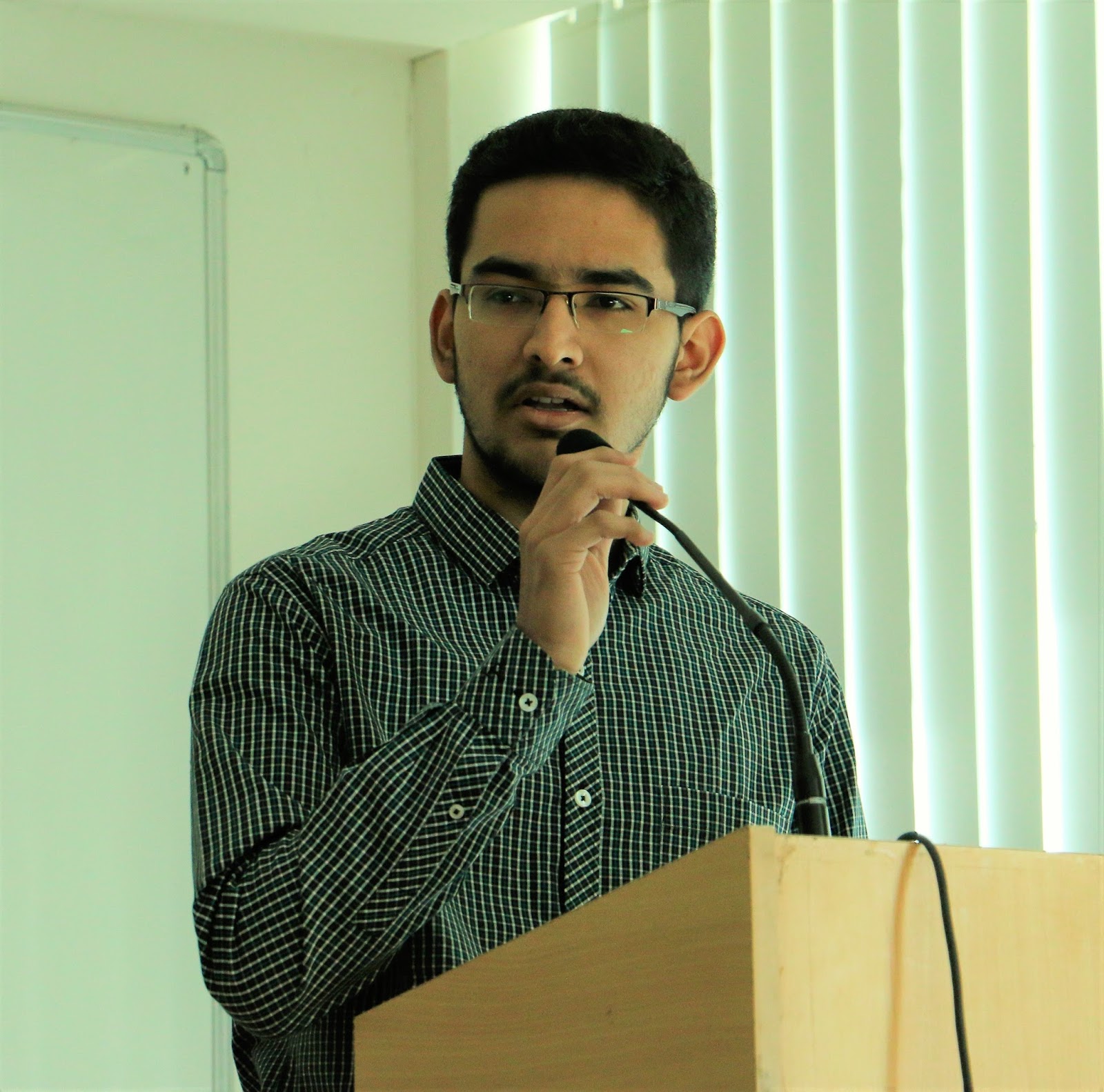
The Dean of FoaL, Mridul ma'am expressed her immense pleasure and pride at the launch of the journal. She expressed her happiness as the club is constantly growing and the journal is yet another milestone in its glorious path. The HoD, Dept of Arts, Dr. Anthony sir, then graced the event by his kind words. He emphasised on the sickness of individualism and ‘social amnesia.’ We need an instrument for expression, a passage, a reflection that touches the real concerns of the society. A project like this in our times has its own significance. He also emphasised on the power of words. He appreciated the authors and set his hopes high for this journal to continue. The President, Prof. Sandeep Sancheti sir, congratulated everyone on the success of the journal. He accentuated on the idea of reading more, understanding more and discussing more. He congratulated Akash Dayal for leading the team and Subhoshree Mitra, the student editor for the journal. He also showed his enthusiasm on reading the papers written by some of the budding writers like Westernization and Modernization by Jigyasa Kirti and Psychology of Dreams by Sadvansha Munshi. The vote of thanks was presented by Subhoshree Mitra.


Monday, 3 April 2017

Report on ICPR Periodic Lecture

The Dept. of Arts (Philosophy), SHSS, supported by Sophia Club, Manipal University Jaipur had organized a guest lecture on the topic ‘Law and Morality’ which was attended by students and faculty members of the School of Humanities and Social Sciences in a considerably large number. The speaker for the lecture was Prof. Kusum Jain, Former Professor of Philosophy in University of Rajasthan and Member of ICPR, New Delhi. Dr. Anthony S. Raj, Professor of Philosophy and HOD of Dept. of Arts, heartily welcomed and introduced the speaker. 

Legal rules are created by formal institution whereas morals are principles of right and wrong which can differ from person to person. Morals lie within human psyche, which is exceedingly protean and erratic. At first law and moral seem to be analogous. But it is not difficult to realize the difference between them. What is actually legal according to the constitution and what should be legal but is not, are very diverging notions. What should be legal can nearly signify what is morally just. Morality and law are not cognate but diverging. The law can’t head the desires and reasons inside a human psyche. Morality often depends on a person’s intentions and character. The opinions others have about morality are a secondary concern for most laws. 

Law and morality both are normative system of our society. The only difference is that law can be created or changed anytime while morality exists and differs from person to person. Morals are evolved as feelings within society. What may be moral for me, might not be moral for you and what is not moral for you, might not be moral for me. For example, Gay rights are legalized in the USA and many other European countries but they are not legalized in India. Another example is Euthanasia. It’s still debatable if it’s moral or not. Some people might think of this legal consent for painless death as moral but some might not, as they consider other factors too, such as family. On the contrary, we cannot oppose the fact that the major notions in law are derived from morality. For example, criminal law is an outcome of moral beliefs. There is no doubt a strong analogy between Law and Morality. Law can be used to implement the sanguine moral in some conditions where morality has a lucrative and favorable effect on the society.

After the lecture was concluded, an interactive Q&A session followed. The vote of thanks was given by Dr. Robin Luke, Assistant Professor of Philosophy, Dept. of Arts.

Tuesday, 21 March 2017

Off The Cuff – Extempore Competition

On the 17th of this month, Sophia Club conducted an extempore competition where the speakers were judged both on their knowledge of philosophy and the ability to express their thoughts. The competition was held in two stages. 

The judges of the extempore
The first stage, which was the qualifying round was a quiz on modern and Indian philosophy. The quiz was mind grilling and six out of ten teams qualified for the next round that was the extempore. The extempore was a little different than the conventional kind as a team of speakers had to take a topic each from the two topic bowls and the second speaker had to connect to what the first speaker had delivered. The topic bowls had a number of topics like women of today, social media in a democracy, Donald Trump’s presidency, Indian education system and many more which were worked upon with meticulous effort by the speakers. 
First Stage : Quiz
The event was judged by Dr. Anthony sir and Prof. Robin sir who had a tough time judging as all the speakers spoke very well. 

The winners were announced to be Paras Chhetri and Neha Kangralkar.  The first runner up were Sankalp Pareek and Ritisha Gupta and the second runner up were Devansh Agarwal and Ashish Rariya. 

Dr. Anthony and Prof. Robin
After the event, Dr. Anthony sir and Prof. Robin sir congratulated all the participants for their pensive thoughts and scrupulous efforts put into each topic. Dr. Anthony sir and Prof. Robin sir were presented with a small token of gratitude by the office bearers of Sophia Club for their support in conducting the ongoing activities of the club.
The Winners

The Second Runner Up
The First Runner Up
 
Group Photo of the Organizers and the Participants.

Thursday, 26 January 2017

Report on guest lecture on “Ecological Citizenship and Ethical Burial”


The Dept. of Arts (Philosophy), SHSS, supported by Sophia Club, Manipal University Jaipur had organized a guest lecture on the topic “Ecological Citizenship and Ethical Burial” which was attended by students and faculty members of the School of Humanities and Social Sciences in large numbers. The speaker for the lecture was Dr. William Sweet, Professor of Philosophy and Director of the Centre for Philosophy,
Theology and Cultural Traditions at St Francis Xavier University, Nova Scotia, Canada. Dr. Anthony sir, Professor of Philosophy and HOD of Dept. of Arts, welcomed and introduced the speaker. Dr. William Sweet was honored by Prof. Manju Singh ma’am, Director, School of Humanities and Social Sciences and Dr. Anthony sir.


The lecture started with Dr. William Sweet sir emphasizing on the importance of ecological citizenship. The humanity is going through an increasing ecological crisis. In response, a number of governments have adopted a number of policies. The lecturer also stressed on the seven basic claims of ecological citizenship. There is no fundamental difference between origin of humanity and the origin of life. Basic ecological values and all natural things  are inherently related. All life should exist in ecological balance. Ecological citizenship theory recognizes limits of resources on earth. Given population size, ongoing population growth and growing industrialization, there is a need to safeguard the natural environment. Human beings over the course of their existence have come to require a number of desires, abilities and powers. There is always desire for gaining more in life and these desires only end in death. Human beings should control desires and use technology to return humanity to a level of existence that establishes and maintains ecological balance.
 
Human beings like to celebrate death. The value of a person’s life is measured by how big and extravagant a funeral is organized for them; the bigger the tomb, the more important the person. Ethical burial accentuates the proper relationship between human and nature. There is an increasing need to protect and preserve the land effected by traditional burial practices so that the environment can return to its previous state. Green burial is not only important for respect of nature but also for respect of human beings. Our lives are just appreciated for its materialistic values. The quality of living has been reduced, and why, just because of our insatiable need for materialistic and profligate living.


A well-ordered ecological environment can only become a reality if there are adequate resources, diverse species, efficient energy and a balanced ecology. There has to be harmony between nature and human. Every year around ten million people die in one part of the world. Just imagine what amount of perfectly good land is wasted if approximately two sq. meters of land is used to bury a person. Green burial needs to be put into practice so that we can hope for a better future as it will provide us with more farmland, clean water and more resources. Resources we have now are not for us to exploit but to share with the future generation.

After the lecture was concluded, an interactive Q&A session followed. Dr. William sir was then offered a memento from Sophia Club. The vote of thanks was given by Dr. Robin Luke sir, Assistant Prof. of Philosophy, Dept. of Arts.